Lambing Flat Gold Rush
Burrangong Goldfield, Young, New South Wales (1860–1861)
Aboriginal and Torres Strait Islander people are advised that this page may contain images and names of people who have died.
Date range
1860 – 1861
Rioters
Estimates of 2,000–3,000
Discovery
1860, on a sheep run used for lambing
Town Today
Young, NSW
Worst Riot
30 June 1861
Chinese Miners
~2,000 by early 1861
Political Result
NSW Chinese Immigration Restriction Act, November 1861
Map: Lambing Flat Gold Rush (-34.31, 148.30)
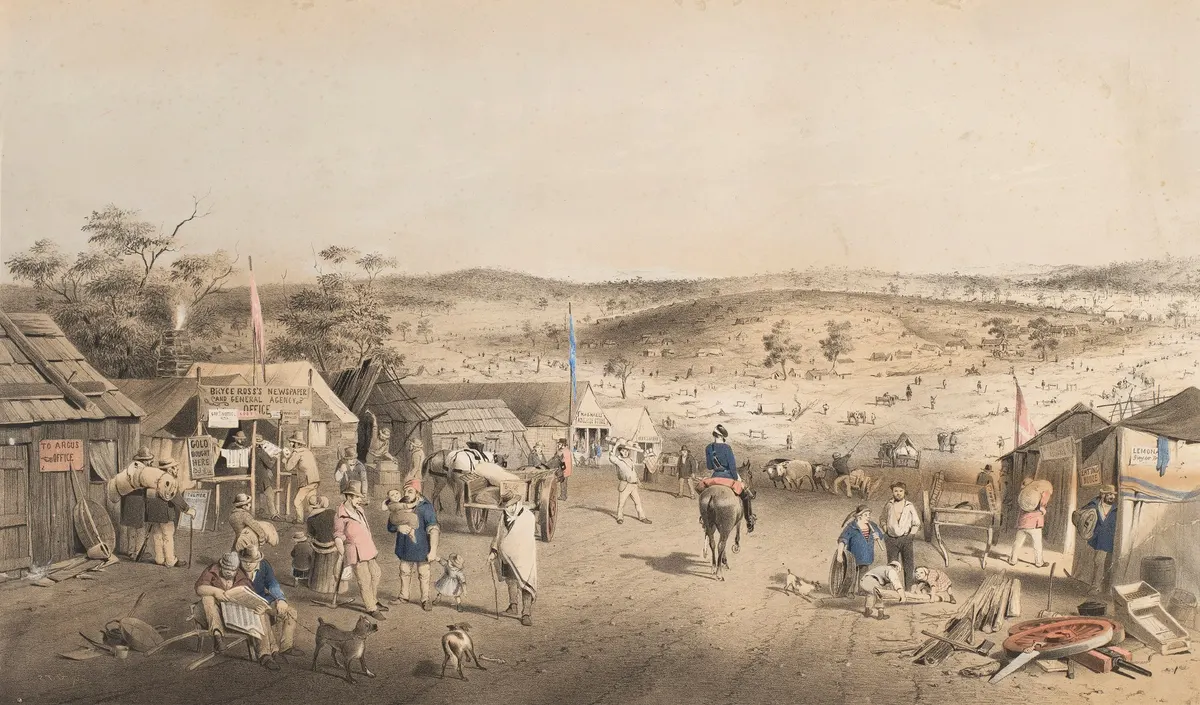
Gold on the White family's lambing paddock near present-day Young drew thousands in 1860, including many Chinese miners who had come from Victoria and Kiandra. Between November 1860 and mid-1861 the Burrangong field saw a drawn-out series of anti-Chinese attacks — arguably the most serious civil disorder in colonial NSW, longer and larger than Eureka.
The worst came on the night of 30 June 1861, when a mob of perhaps 3,000 men marched behind a "Roll Up – No Chinese" banner, drove Chinese miners off Lambing Flat and Back Creek, burned tents and looted property. Many were beaten. Troops restored order, a few ringleaders were jailed, and Chinese miners petitioned the government for compensation.
The colony's response was the Chinese Immigration Restriction Act of November 1861, an early step toward the White Australia policy. The original Roll Up banner survives in Young.
Timeline
Gold found at Lambing Flat; Burrangong field gazetted
November–December: First attacks on Chinese camps
January–February: Further expulsions; Premier Cowper visits
12 March: Su San Ling Doh writes the first Chinese petition to the Governor
30 June: Major riot at Lambing Flat and Back Creek
November: Chinese Immigration Restriction Act passed
Notable Figures
The riots are remembered as a turning point in Australian racial politics. The Roll Up banner is State Heritage listed and held by the Young Historical Museum (formerly the Lambing Flat Folk Museum), and Blackguard Gully, a riot site, is on the NSW State Heritage Register and is now public space.